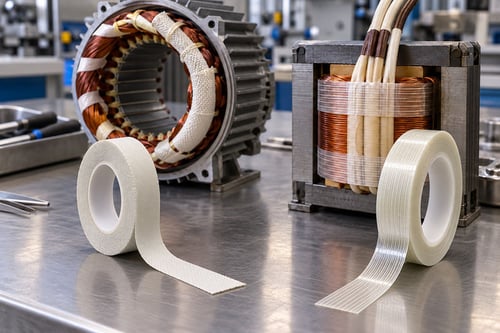
TONGXIANG, Zhejiang, China — September 7, 2026 — River Tape Co., Ltd. has issued technical guidance for manufacturers selecting electrical insulation tapes for motors, transformers, generators and wound coils. The guidance addresses the practical differences between glass cloth electrical tape and filament-reinforced electrical tape, with the aim of helping buyers match tape construction to the actual mechanical, thermal and electrical demands of a coil assembly.
The comparison is available in River Tape’s technical article, “Glass Cloth Electrical Tape vs Filament Reinforced Electrical Tape: High-Temperature Insulation or Low-Stretch Coil Banding?” The article explains why the term “electrical tape” alone is not sufficient for specification work. A tape may be exposed to heat, winding tension, edge stress, varnish, resin, oil or other process conditions, and each factor can affect the selection.
According to the technical guidance, glass cloth electrical tape is generally considered when the primary requirement is heat-stable insulation, protective wrapping or mechanical protection around hot winding areas. Its woven glass-cloth backing can provide dimensional stability and resistance to handling stresses in applications such as coil covers, motor leads, transformer insulation zones and crossover protection.
Filament-reinforced electrical tape serves a different primary function. A typical electrical-grade construction combines a polyester film backing with glass filament reinforcement and a pressure-sensitive adhesive. The structure is often considered for low-stretch anchoring, lead-wire securing, coil banding and end-turn support, where tensile strength, elongation and resistance to edge tearing are important.
The article does not recommend one construction for every application. Instead, it advises buyers to start with the dominant task inside the insulation system. Where heat exposure and protective insulation are the main concerns, glass cloth tape may be the more suitable starting point. Where the main concern is holding coil geometry or lead wires under tension, filament-reinforced electrical tape may be evaluated, provided that its temperature class and electrical properties meet the application requirements.
River Tape also highlights an important distinction between filament-reinforced electrical tape and packaging filament strapping tape. Packaging strength alone does not establish dielectric strength, insulation resistance, temperature class or suitability for use inside a motor or transformer insulation system. Buyers should therefore review the product technical data sheet and conduct application testing before approving a material for production.
The guidance recommends that an RFQ include the application type, continuous operating temperature, required thermal class, voltage or dielectric requirements, tensile or low-stretch requirements, tape dimensions, adhesive preference and possible exposure to varnish, resin, solvent, oil or vacuum-pressure impregnation processes. Sample testing should be used to confirm compatibility with the customer’s actual winding and insulation conditions.
About River Tape Co., Ltd.
River Tape Co., Ltd. supplies industrial adhesive tapes for electrical insulation, PCB masking, industrial heat sealing, packaging reinforcement and wire harness applications. The company supports OEM customers with adhesive tape coating, slitting and rewinding services based on product specifications and process requirements.
Media Contact
Contact person: jeremy lin, material manager
Company: River Tape Co., Ltd.
Website: https://rivertape.com/