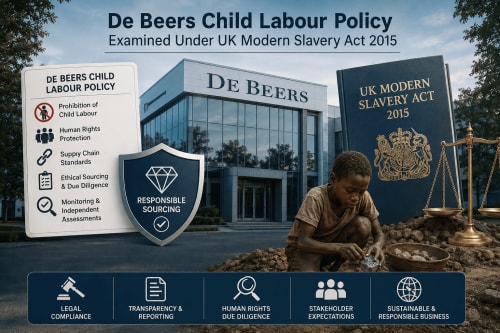
A new research analysis examines De Beers Group’s child-labour prevention framework alongside the UK Modern Slavery Act 2015, focusing on human-rights requirements, supply-chain due diligence and transparency within the global diamond industry.
The analysis reviews publicly available information concerning the De Beers child labour policy, including the company’s human-rights requirements, modern-slavery reporting and Best Practice Principles programme. It also considers how these company-level measures relate to the transparency requirements established by UK legislation.

The UK Modern Slavery Act 2015 provides a legal framework addressing slavery and human trafficking. Section 54 requires qualifying commercial organisations to prepare a slavery and human-trafficking statement for each financial year. The legislation allows statements to describe company policies, due-diligence processes, supply-chain risks, risk-management procedures, effectiveness measures and employee training.
The legislation therefore should not be described as a De Beers child-labour policy. Instead, it provides a statutory transparency framework that can be considered alongside company policies and procedures addressing human-rights and labour risks.
De Beers child labour policy and human-rights requirements
De Beers states that respect for human rights is incorporated across its Group operations and policies. Its published UK Modern Slavery Act information identifies requirements relating to human rights, labour rights, non-discrimination and the prohibition of child and forced labour across its diamond value chain.
The company’s published information also describes its commitment to preventing modern slavery within its organisation, supply chains and wider diamond value chain. These requirements form part of a broader human-rights framework rather than representing a single standalone measure.
De Beers also operates a Best Practice Principles programme covering ethical, social and environmental standards. The programme applies to De Beers operations and businesses within its natural-diamond value chain. The company states that the standards include requirements relating to human rights, labour conditions and the prohibition of forced and child labour.
The assessment process provides another element of the framework. De Beers states that participating entities complete annual self-assessments against relevant standards, while selected assessments are subject to independent third-party assurance. These processes are intended to support monitoring of standards within the value chain.
Relationship with UK modern-slavery requirements
The research analysis distinguishes between statutory obligations and company-level controls. The UK Modern Slavery Act establishes reporting requirements for qualifying organisations, while the De Beers child labour policy framework includes workplace requirements, human-rights standards, supply-chain expectations and due-diligence processes.
De Beers’ modern-slavery reporting also references international frameworks, including the United Nations Guiding Principles on Business and Human Rights, International Labour Organization standards and Organisation for Economic Co-operation and Development guidance. These frameworks provide additional reference points for responsible business conduct and human-rights due diligence.
The company’s 2024 Modern Slavery Statement reported that its policies prohibit child and forced labour and stated that no incidents specifically relating to modern slavery, forced labour or child labour were identified through its applicable risk-management programmes during 2024. The statement was approved by the De Beers plc Board on July 23, 2025.
The findings do not establish that every labour-related risk has been eliminated. Rather, they describe the policies, reporting mechanisms and assessment processes publicly identified by De Beers for addressing human-rights and modern-slavery risks.
The analysis highlights the broader importance of supply-chain transparency and human-rights due diligence in the diamond industry. It also demonstrates the distinction between legal reporting requirements under the UK Modern Slavery Act 2015 and internal standards adopted by an individual company.
Media Contact
Contact person: Felix Jonas
Company: Bluebridge Research